
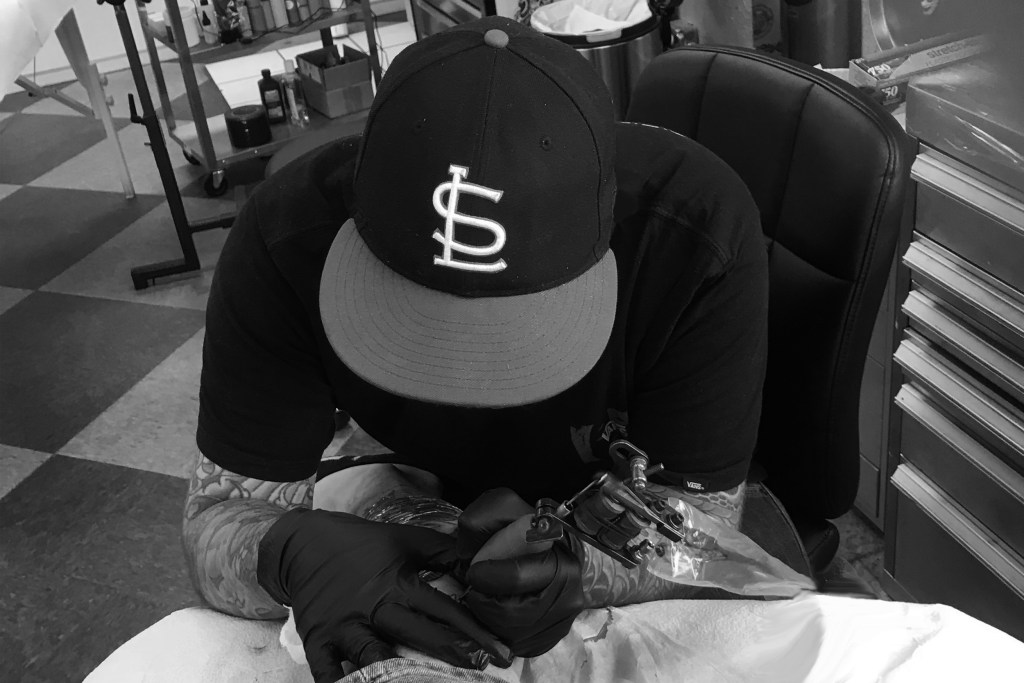
So it worked, the title got you thinking. In Revelation 19:16 it says, “…on his thigh he has this name written: king of kings and lord of lords.” is this verse speaking of a tattoo like inscription on Jesus’ leg?! Some people have said “Yes” and used this to argue for tattoos, while others use verses like Lev. to argue against. So which is it? Let me steal some of your time to dive further into this topic.
So, is it wrong for a Christian to get tattoos? If your answer to this question is NO because your pastor has a tattoo, you need to go a bit deeper. I like to start off this conversation by simply asking, “What is our authority in this matter?” Well, if you are a follower of Christ, it’s Scripture. So, what does the Bible have to say about getting tattoos? To be honest, not much. Even so, over the next few paragraphs I would like to look at scripture to help us understand this topic from a biblical perspective.
The most common verse that people point to in opposition of tattoos is Leviticus 19:28
“‘Do not cut your bodies for the dead or put tattoo marks on yourselves. I am the Lord.” Leviticus 19:28
Seems pretty straight forward, case closed. But not so fast. One of the issues with trying to use this verse as a Christian, is that it wasn’t written to Christians. It was written to Jews in about 3500 BC. In fact, the whole Old Testament was written to Jews and for Jews.
As a Christian, I absolutely love the Old Testament, but it’s important that we use good exegesis when studying it. The Old Testament, or to be more precise the Old Covenant, was a temporary and conditional covenant between God and His people. Here’s what I mean by covenant, a legal and loving agreement between God and people that stipulates the conditions of their relationship. The Mosaic Covenant in the Old Testament is a sort of, “I will if you will agreement.” The laws in the Mosaic Covenant were meant to set the Jews apart from the surrounding nations. Verses like Leviticus 19:28 were part of the Mosaic Covenant found in the Old Testament and were meant to establish a nation, it was never meant to be about salvation.
Here’s why this is relevant, we see in the New Testament that Jesus fulfilled the Old Covenant and now as Christians we get to be a part of the New Covenant and a new relationship. (Matthew 5:17-18) This New Covenant is permanent and unconditional. A sort of “I will even if you won’t.” agreement. As Christians, we read the Old Testament to learn about God’s character, to gain wisdom and to learn from people’s mistakes. The reality is that as Christians, we should appreciate the Old Covenant, but we are not under the Old Covenant.
- Hebrews 28:13 By calling this covenant “new,” he has made the first one obsolete; and what is obsolete and outdated will soon disappear.
- Galatians 3:24 The law was our guardian until Christ came that we might be justified by faith. Now that this faith has come, we are no longer under a guardian.
This is the same reason that we as Christians do not follow many of the Old Testament commands. In fact, the verse right before Leviticus 28 says “‘Do not cut the hair at the sides of your head or clip off the edges of your beard. Leviticus 19:27 So dudes, when was the last time you got your sideburns trimmed?
Just a few verses above that, in verse 19 it says, “‘Do not wear clothing woven of two kinds of material.” Now before you leave your beloved barber or go throwing away your favorite blended cotton and polyester shirts, remember, these commands weren’t written for you and me. God relates to us in the new way of the New Covenant.
It’s not a surprise that many people have a hard time understanding this transition from Old to New. Even some of Jesus’ closest followers, including Peter, struggled with this transition as we see in the book of Acts (Acts Ch.10-11)
Paul, in Galatians, actually warns Christians against being burdened by religious demands.
- Galatians 5:1 It is for freedom that Christ has set us free. Stand firm, then, and do not let yourselves be burdened again by a yoke of slavery.
- Galatians 5:6 For in Christ Jesus neither circumcision nor uncircumcision has any value. The only thing that counts is faith expressing itself through love.
I find it interesting that the burden Paul speaks of came in the form of religious people telling others whether or not they should have specific outward marks on their body. I don’t think it would be a jump to imagine Paul speaking to modern day Christians saying, “For in Christ Jesus neither “tattooed” nor “un-tattooed” has any value. The only thing that counts is faith expressing itself through love.”
There is nothing in the New Testament that speaks to tattoos as an inherently immoral or moral behavior. In other words, getting a tattoo isn’t a moral issue. Getting ink is no less moral than eating pork or getting your beard trimmed.
Can I tell you where we really got the idea that tattoos are bad for Christians? TRADITION. When it comes to any tradition that we hold, we have to wrestle with this question: What do I do when uncomfortable truth challenges comfortable tradition? For some, this means that I have to come to terms with the truth that, just because I don’t prefer tattoos doesn’t mean that it’s wrong for people to have them.
One of the reasons it’s so important to get this right is because when tradition and truth get mixed, the Gospel gets MISSED and God gets DISMISSED. Are there immoral acts which are prohibited in the New Covenant? Of course. And yet getting tattooed isn’t one of them.
We need to understand that our moral behavior isn’t what saves us in the first place, it is Christ sacrifice for us on the cross which saves us. As Christians, works and moral behavior are evidential of Christ work in us, not contributory to our salvation. In Christ, we are fully loved and fully accepted apart from our behavior.
When it comes to tattoos, it seems that the meaning and reason behind the tattoo is far more important than the physical act of getting ink in your skin. In getting a tattoo, the goal should be the same as everything we do as Christians, to love God and love others as He defines love. That means as Christians, if we choose to get tattoos we should strive to celebrate God’s greatness through the expression of what we choose to mark ourselves with.
Here are 6 helpful questions I like to ask before getting a tattoo.
6 helpful questions to ask before you get your first or next tattoo:
- Can I afford it?
- Will it dishonor people?
- Will it hinder my career path?
- Is the shop safe?
- Will I like it?
- Can I wait 4 months and still want it?
At the end of the day, it’s a question of wisdom. My friend Eric says it this way, “It might not be wrong but it might not be wise.” We want to ask the question, “What is the wise thing to do?”
My hope is to prevent myself and others from falling into the trap of mixing and matching the Old Covenant with the New Covenant. When we do this, we can get all sorts of weird, mixed up theology. Whether you agree or disagree with my conclusion, I would love for this to start a conversation. For a great resource on understanding how to read the Old Testament and the New Testament, here is a link to a message series that my church did on this topic just last month called, “Mix and Match.” http://smccutah.org/sermons/series/mix-match/?page=1
As always, I hope you found this article helpful and hopeful.
 Speaking Your Lingo
Leave a comment