
Overview of the Book:
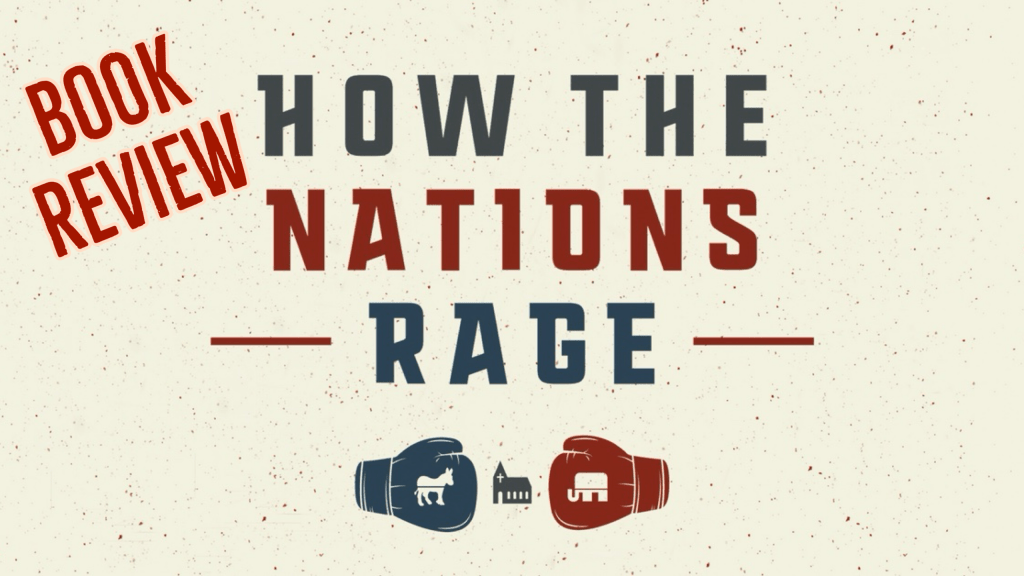
How the Nations Rage: Rethinking Faith and Politics in a Divided Age, written by Jonathan Leeman, is a book focused on rethinking how Christians should view and engage in politics in our modern world.
My overall thoughts on the book:
The book started out strong and I thoroughly enjoyed the beginning BUT things declined quickly. In this review, I will share what I enjoyed as well as what I thought was lacking.
The portions that were most helpful:
Leeman does a good job of clarifying how we should understand separation of church and state. At one point he states, “The separation of church and state is not the same thing as the separation of religion and politics.” (p.12) All of us, whether we consider ourselves religious or not, bring our moral convictions into the political square. He adds to this by stating that good governments are important and necessary for life and the church. “After all, good governments are prerequisites to the rest of life, including the life of the church.” (p.15) He also goes on to say that it is short-sighted for anyone to claim that, “governments don’t matter.”
Later, Leeman does a decent job separating what it means to be a Christian and what it means to be an American. In other words, our greatest allegiance as Christians is to Christ, not America. He also goes on to make a similar distinction when it comes to our view of political parties.
Although I appreciate the fact that Leeman states that Christians should enter the public square and engage in politics, he also seems to push for the idea that Christian influence in the public square is basically futile. I admit this is subtle. It’s almost as if he leaves the impression, “Yeah get involved in politics, you should, but nothing you do will ultimately matter or make a difference.” This seems to be a result of a Calvinistic lens.
The last thing I’ll mention that Leeman does well is help his reader by distinguishing between straight and jagged-line issues. (p.92) This might be the most helpful idea in his book. In other words, we do not want to be overly divisive with every political issue we disagree on. With that, he shares great insight when he states, “It’s easy to err in at least one of two directions. Either we can assume that the Bible says nothing on matters of public policy… Or we can treat the Bible like a book of case law.” (p.79)
Now for what was lacking:
The overall issue with Leeman’s book is that he tries to take a neutral stance with many weak nonpartisan arguments. It’s hard to get on board with his theory of politics which acts as if the right and left are on neutral ground in their orientation to Christianity. Yes, of course our identity should not be wrapped up in where we land on the political spectrum, but the left and right are not equal in their virtues. For example, Leeman states, “To Christians on the political left I would say, make no piece to the Democratic Party’s position on abortion. Fight against it. Make noise. To those on the right I would say, make no peace with any vestiges of white supremacy in the Republican Party. If you work in law enforcement, for instance, you have a great opportunity to be one of the most vocal in opposing it. Christians on both sides of the aisle will need to think carefully in coming years about how to make peace with friends identifying as LGBT while also affirming God’s purposes for marriage and sexuality.” (pp.163-164)
He actually gets things right when he analyzes the political left because the left clearly supports abortion. It is part of their party platform. Their leaders push for it. Most Democrats are in favor of it. But then he goes off in his nonpartisan argument acting as if the political right and Republicans stand for racism or white supremacy. That is not part of the Republican platform. It would be a stretch, to say the least, to find it anywhere in the Republican policies of our current day. It’s simply a strawman argument to try and maintain this “nonpartisan Christian position.” Yes, there might be a small extremist sect of people on the right who stand for white supremacy but it doesn’t represent the vast majority. Whereas, affirmation of the LGBT lifestyle, poor gender ideology, abortion, and a Marxist ideology are pushed forward by the political left both in policy and platform.
I agree with his stance that someone doesn’t have to be a Republican to be consistent as a Christian. As Christians, we should work hard to make sure that people do not conflate the two as the same thing. We should also not hold our political views and parties to the level of the Gospel. Yet at the same time, how can one ignore:
- The right is pro-life and the left supports abortion
- The right supports traditional marriage and the left affirms LGBT
- The right says that biology is the basis of gender and the left says you can choose and change your gender
- The right supports freedom of religion and the left tends to push back against religion
- The right supports traditional families and the left does not
The list could go on but aren’t almost all of these “straight-line” issues? The issue with the left is not just political but the fact that they have an incoherent worldview undergirding their politics. At the very least, I could see someone arguing for a view that one should not too closely align themselves with any political party as a Christian. But not a view that essentially says aligning with either side is a valid option for a consistent Christian.
Lastly, I would like to have seen a more robust discussion on how we should view government in light of what we learn from the Old Testament and Israel as well as the New Testament. For instance, I would have liked a discussion on the differing perspectives on how one should interpret Romans 13. I also would have liked a discussion on how we in America specifically, a nation founded on the idea of popular sovereignty, should apply Romans 13.
Conclusion:
Overall, I give this book a 3 out of 5 stars due to the reasons mentioned above. I appreciate that it challenged my perspective and caused me to think. Yet, I wish the book had finished as well as it had started.
 Speaking Your Lingo
Leave a comment